
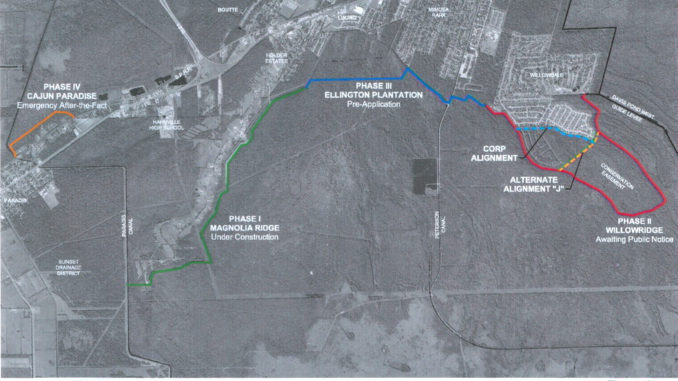
While St. Charles Parish inches closer to receiving a permit to start Phase II of the West Bank Hurricane Protection levee, there are concerns that it won’t be finished fast enough to offset potential problems caused by the Western Tie-in.
The tie-in is a 4-mile system of levees and floodwalls that will follow the contour of the Davis Pond Diversion from the Lake Cataouatche levee south of Waggaman to the Mississippi River levee near Ama. The new levee is expected to protect the western end of west Jefferson and Ama from storm surge coming up the Barataria Basin through Lakes Cataouatche and Salvador. It is scheduled to be completed in 2011.
The Army Corps of Engineers needs the tie-in to close a 4-mile gap in the 66-mile West Bank storm-surge protection system. Tie-in project manager Jeff Williams said that corps’ models show that the project should cause no additional flooding to St. Charles Parish in case of a storm event.
But while the tie-in will add protection to Ama, some council members said it would make other areas on the West Bank of the parish more susceptible to flooding.
“When you build that levee, the water has to go somewhere,” Council President Terry Authement said at a recent council meeting. “With our area open on the western end of the diversion, that leaves us more vulnerable.”
Councilman Dennis Nuss agreed with Authement, saying that the project will only worsen any problems the West Bank of the parish experiences from future hurricanes.
“Ama appreciates the protection, but this is not a good project when you look at the big picture,” he said.
Donaldsonville-to-the-Gulf, which will add much needed protection to the West Bank of the parish, is scheduled to start construction in 2012.
Until then, the parish is hoping to get started on building its own West Bank levee.
“The bottom line is that the parish is closer to getting a permit than we’ve ever been before, but we can’t provide a date for this to happen at this time,” parish spokeswoman Renee Simpson said.
Right now, Simpson said the parish’s goal is to permit Phase II of the West Bank Hurricane Protection levee as soon as possible.
A levee there would eventually protect Willowdale/Willowridge from flooding when the levee is complete. The parish will then try to get a permit for Phase III, which would connect a Willowdale/Willowridge levee with the Magnolia Ridge levee which has been partially constructed.
“We are currently working on a process to move forward with land acquisition as soon as the final alignment and permit for Phase II are secured,” Simpson said. “Modeling for Phase III of the levee is ongoing and the application for the permit will follow after receiving the permit for Phase II.”
Simpson said that once the parish receives a permit for Phase II, it may be possible, with approval from the Department of Natural Resources and the corps, to grub and clear the land along the approved alignment.
“Also, with their approval, we may be able to raise the elevation of the land to a point that would make it possible to install temporary control structures and use flood control devices such as tubes, sand bags and HESCO baskets,” she said.
Because neither Phase II nor Phase III are federal projects, the parish is left to hope for federal help at some point.
“We are setting ourselves up to make sure any levee construction we do on our own is up to corps standards,” Simpson said.
Though the parish is close to getting a permit for Phase II, Simpson said that it’s doubtful that a levee could be finished at the same time as the Western Tie-in.
“We are working as quickly as possible to get to a point where we can begin construction through land acquisition and permitting,” Simpson said. “Donaldsonville-to-the-Gulf may or may not come in before our levee, but when it does it will provide a first line of protection for the West Bank.”
Right now though, the parish wants residents on the West Bank to know that whether the Western Tie-in makes matters worse or not, they’re still very vulnerable in case of even a slow-moving Category 2 storm.
According to EOC head Scott Whelchel, a slow moving Category 2 storm could threaten anyone with a home elevation of less than 8 feet. Right now, 80 percent of the structures in the parish are at an elevation of 5 feet or less.
A Category 3 storm could threaten 80 percent of the structures on the West Bank, Whelchel said.
Be the first to comment