
Successful deer hunting stems from changing plans
Deer have already patterned many hunters. They know the times you arrive and the time you leave. They’re watching you.
Sunrise to 10 a.m. and 3 p.m. to sunset are your primary times. So, start hunting from 10 a.m. to 2 p.m. and you will see more moving.
Other hunters move at these times forcing deer to scuffle around them. And that will occasionally push deer on to you.
This past weekend I went to put corn in my feeders around noon and to clear some small branches in the shooting lane.
At 1:10 p.m. I sat down to enjoy the wildlife activity and wait for the sun to go down. I put my radio headset on to pick up a college football game. Then I noticed movement to the right. Walking out were two does and right behind them was an 8-pointer.
The time was 1:20 p.m. I had just walked that shooting lane and probably left some type of scent and my four-wheeler was parked 200 yards from the deer.
They were undisturbed as they walked across my shooting lane. They never stopped and by the time I raised my gun they were gone.
Prior to the deer walking out, I noticed the coons, doves, crows, and squirrels had scattered.
Most hunters do not like to see coons and squirrels under their feeders eating corn. Personally, I allow it because tips me off when big game is approaching. I recommended using this to your advantage.
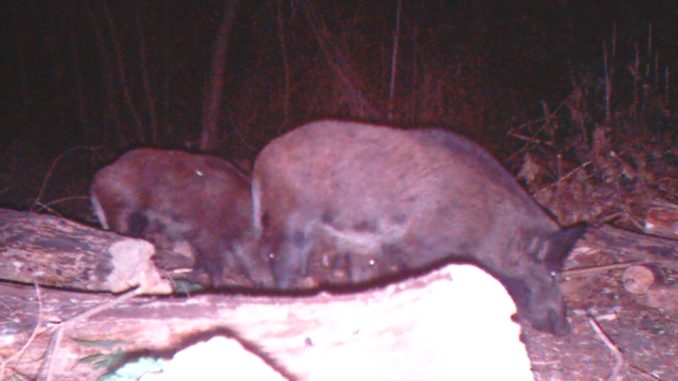
Churchill pigs
Wild pigs have been harvested in every parish of the state. To help keep the numbers of wild pigs down in the State, the Lousiana Department of Wildlife and Fisheries allows hunters to hunt pigs 365 days a year.
All state hunting laws apply for harvesting of wild pigs.
So, what makes the wild pigs such a nuisance? They eat everything. They dig up plant life, eat ground-nesting birds, and can disrupt an eco-system quickly.
Wild pigs can also breed and reproduce in 100 days. Most litters can have a surviving head count from 1 to 12 piglets.
I consider wild pigs a “modern-day dinosaur.” If you have a chance to shoot one in the state, please do so. Wild pig meat is great for making sausage, ground meats or any other specialties used like deer meat.
Bird hunters
The East and West Zones both open Dec. 13, but the West Zone will close Jan. 18, 2009 and the East will close on Jan. 25, 2009.
Woodcock hunters, the season will open Dec. 18 and close Jan. 31, 2009. Possession is three birds. The third split of dove season opens Dec. 20 and closes Jan. 5, 2009.
Salvador fishing
Fishermen are still catching specks and reds in Lake Salvador.
From the mouth of Bayou Couba to Bayou Villares, good fish are being produced.
Courtney Mongrue and Ms. Carol have report low numbers of fishermen at Pier 90, but the fishermen that have gone out have caught fish.
The best baits have been the glow, white, avocado, purple and white, black and chartreuse, chrome rattletrap, and the ¼ ounce gold spoon.
Bass and sac-au-laits have been caught in Lake Cataouatche were you can find clear water. Sac-au-laits are hit and miss.
Fish the edges of the grass lines in the lake or fish the wellheads in the middle of the canals in the Management Area.
Best baits for sac-au-laits have been the black and chartreuse, and blue and white. If you can catch grass shrimp your chances increase for a better catch.
Bass have been hitting the white spinner baits, the watermelon-red metal flake worm, and the bream-colored rattletrap.
Finding clear water is the key to a fisherman’s success.
Fishing in Lafitte
Andrew Callias fished the Lafitte area this past weekend.
The pens were low and the water was muddy.
Many of the boats were having trouble locating speckle trout.
The best baits for the pen and surrounding area were the white beetle, black and chartreuse, and the salt-n-pepper with a chartreuse curly tail.
Many fish had been caught prior to Saturday, which was ahead of a cold front. Andrew and his crew moved into the Texaco Canal where they found sheepheads, reds and black drum in deep holes.
They used market shrimp on a jig head.



Be the first to comment