St. Charles Parish recently kicked off its America 250 celebration with the Louisiana Philharmonic Orchestra with its Let Freedom Ring concert, one of several planned events celebrating the nation’s milestone.
America’s bicentennial took place in 1976 – and that milestone was celebrated during a time of major formative events in St. Charles Parish’s history.
“There were a lot of very interesting things happening in the parish in the early 1970s, and especially in 1976,” said Bert Laque, son of former Parish President Albert Laque who at the time served as the parish’s first Parish Administrator.
The younger Laque was part of the very first graduating class that attended what is the current Hahnville High School site. 1976 marked the opening of both Hahnville and Destrehan high schools at their current sites, and this year marked the 50th anniversary of those graduating classes.
“It’s funny because so many people still call (the current HHS) the ‘new school,’ and here we are 50 years later,” said Laque. “Everyone calls it the new school, and it’s old by now.”
The original Hahnville High School was located on River Road in Hahnville from 1924 to 1975 before the school relocated to its present-day site in Boutte to accommodate a growing student population.
“We were asked about what the name of the school should be, and people voted for various names. And I remember, I couldn’t believe it but Hahnville ended up being the name of the school. They kept the name the same despite not physically being in the town anymore,” Laque said.
Laque’s class was one of the few that experienced both Hahnville High School sites. The original site did give him something to remember it by, however.
“I drove to school one day, parked my car … well, there was a bad storm and a telephone pole fell – and guess whose car it fell on?” Laque said with a laugh. “Police came over to the school asking, ‘Who’s this vehicle for?’ I remember people hanging out the window saying, ‘Hey Laque, give me a ride home!’ It was kind of funny.”
Construction on the Luling-Destrehan bridge – now known as the Hale Boggs Memorial Bridge and an iconic image associated with the parish – was also ongoing at the time.
The bridge, when ultimately opened in 1983, would change life in the parish forever.
“Before that, you had to use the ferry,” said Laque. “There was the little Ferry Inn and you’d go buy some peanuts, a soda, while you’re waiting on the ferry. You’d count cars, because the ferry could only hold 25 or 30 cars, and you always hoped you’d be able to make it on the next ferry, because if not, you’re probably waiting another 30 minutes to cross. Sometimes, you’d get two ferries, but at some points it was just one. If you were going over to the east bank, you had that time factor to budget in. And you’d try to time the right time to catch it.
“It was kind of its own little spectacle. Some things about it you miss. Some you don’t,” Laque said. “But it’s all we knew at the time, and you were used to it. That extra access to both sides of the river is a huge difference today. You wouldn’t likely know as many people from the east bank, or vice versa – there wouldn’t be as much interaction.”
The Waterford 3 nuclear power plant was also permitted for construction in 1974, another major happening for the parish.
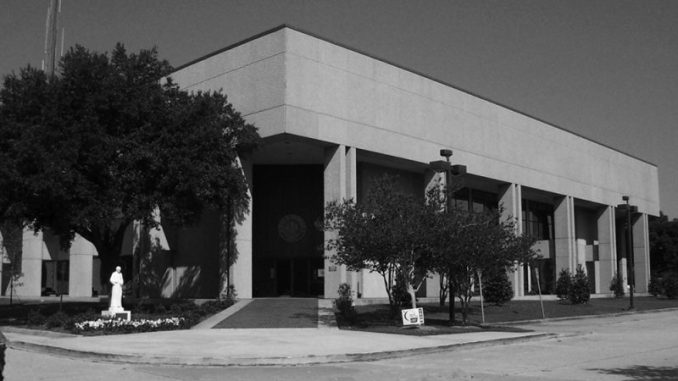
Ditto for the construction of the current St. Charles Parish courthouse, which was completed and officially dedicated in 1976 on the same grounds as the original courthouse.
That is where Laque’s father spent much of his time, both as Parish Administrator from 1968 to 1976, and later as St. Charles’ first – and, to date, only – three term Parish President (1988-1992, 2000-2008).
“He was a busy man, but he loved helping people,” Laque said of his father, who passed away in 2018. “Whatever he could do to help somebody, that’s what he was going to do.”
The new courthouse made a significant impact on day-to-day operations.
“It was so crowded before, they didn’t have room for anything. They had so much more room, and two or three different courtrooms. You had room for people to spread out and actually have the parish government all under one roof – they were able to consolidate a lot that was going on at other buildings into the one courthouse,” Laque said.