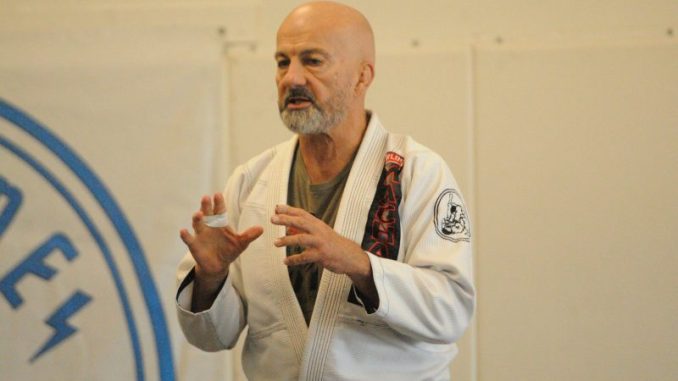
Carlos Machado competed at the prestigious 1998 ADCC Submission Wrestling World Championship with a broken foot.
His solution? Get things done quickly – and that’s exactly what happened as he earned the night’s fastest submission finish.
“In hindsight, I would not have done what I did,” said Machado. “But I feel that a lot of times, you are put in a testing situation in your life, and you go through it.”
The legendary grappler and pioneer of Brazilian jiu-jitsu was in Boutte Saturday to lend his expertise to locals as he led two seminars at Cyclone Brazilian Jiu-Jitsu. Machado held a morning session for children and an afternoon session for adults as students learned from one of the men who popularized jiu-jitsu in America.
Born in Rio de Janeiro, Brazil, Machado began martial arts training at just 4 years old. He is the eldest of the five Machado brothers – Carlos, Roger, Rigan, Jean Jacques and John – and they are cousins to members of the Gracie family. Both families are iconic in the martial arts world.
Machado is a two-time World Masters champion, two-time Pan American Champion and a two-time U.S. Open champion.
He’s often called the “Godfather of Jiu-Jitsu” in Texas as he helped introduce Brazilian jiu-jitsu to the United States in the late 1980s and early 1990s and in particular created a major foothold in the Dallas-Fort Worth area. He holds an eighth degree coral belt, a rare achievement which can only be earned by senior masters who have spent decades teaching and shaping the art.
“A lot of time has passed since the late 80s and early 90s when jiu-jitsu really took grip of martial arts here and throughout the world. It’s very encouraging to see the effects of our initial work,” said Machado. “And yet I still feel there’s a lot to do and more to come. So, I feel super excited.”
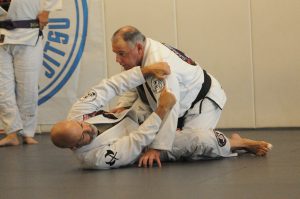 He and his brothers spent years training together and with the Gracies. As one might imagine, competition was fierce among the several grapplers who would go on to prominence.
“Eight hours a day,” Machado said. “We didn’t know anything about breaks, recovery or any of that stuff. It was about sheer amount of mat time. It was a boot camp that never stopped.
“I always joke about that sibling rivalry, that jiu-jitsu wasn’t so much that I liked it but that my brothers would kick my butt if I slacked. It was an incentive to have great relatives, both with my brothers and my cousins and relatives from the Gracie family.”
As many accolades as he’s earned on the mat, Machado said what he is proudest of is the mentorship he’sprovided over the years to so many.
“For me, it’s not so much about the world championships or things like that. It’s the mentoring,” Machado said. “Like kids who were bullied and became more confident and were able to handle the situation in a way that was not aggressive. Parents commenting their kids are getting better grades and more sociable. Adults who are highly stressed and become more emotionally balanced, having better marriages and success in their careers.
“Those are a bunch of little things that might go unnoticed for the average person, but have reached a critical mass for me in my life.”
Machado said jiu-jitsu is something that yields positive effects far beyond the gym for those who practice.
“There are crutches and pillars in life. Crutches are momentary things, fads. Pillars are things that become a steady component of your life. No matter if other things fall apart, that thing holds you steady. I consider jiu-jitsu and practicing lifestyle based on it a pillar of life,” Machado said.
Speaking about the night he competed with a broken foot, Machado noted he suffered the injury two weeks before while training with Jean Jacques.
“It was a highly prestigious tournament … I didn’t want to go to the doctor because I was afraid they’d cast my foot,” Machado said. “I wrapped it up and disguised it by having both ankles wrapped … it was definitely a learning experience for me. I wouldn’t have my students doing that. I look back and realize I could have jeopardized my body in a way that would have been detrimental overall.”
Reny Ramos, owner of Cyclone, has trained in martial arts all his life. He began jiu-jitsu training as a white belt under Jean Jacques.
“When I took over the school, I felt I needed to be back with the Machado family,” Ramos said.
He said it meant the world to have Machado there to impart his wisdom to the students.
“To people not in the jiu-jitsu world, it may mean nothing. But to us, he’s at the pinnacle. He’s one of the pioneers of jiu-jitsu in the U.S. Carlos is such a big figure here in the South. He’s a mentor to me. He’s the type of person that I want to be, and I try to surround my people here with those types of people,” said Ramos.