
Weather patterns changing, director says
Destrehan streets filled with water again this month just a few weeks after the record heavy rains of Louisiana’s catastrophic flooding and only months after the March deluge that hit the South.
“The numbers do speak for themselves,” said Clayton “Snookie” Faucheux, St. Charles Parish’s director of public works. “Weather patterns are changing.”
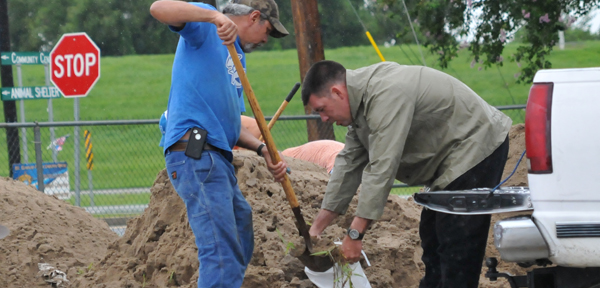
The latest numbers are 4 inches of rain that deluged Destrehan in 40 minutes. Streets flooded and the parish’s “rain plan” kicked in – again.
On Aug. 11, the area was hit by a storm that dumped 3.8 inches of rain in 30 minutes in our area that went on to flood Baton Rouge and Lafayette areas, Faucheux said.
Shortly after, ri sing water also started covering streets in Luling and flood water got close to residences and businesses.
“If it had continued for another half hour, we would have had neighborhoods with severe flooding … that’s how close we were here,” he said of Luling. “We were behind the eight ball with the get-go with the four inches of rain.”
Pump stations were stressed beyond capacity with record levels of rainfall, particularly when the parish’s total hit 16 inches by Saturday during the August storm. Faucheux said the parish can handle about 1-1/2 to 2 inches of water in the first hour and then stations are pushed to keep water levels low.
June through October represents what the Department of Public Works considers its “Super Bowl” because that’s when it has to be at the top of its game.
But Faucheux said there was no way to predict what came this August.
“We knew it was going to be a heavy rain over a period of time, but we didn’t expect anything of what we received,” he said. “Nobody expected for it [storm] to become stationary over us. It was not really organized, but there was circulation. Fortunately for us, we were kind of like in that eye or center. It actually formed in this area, the feeder bans were dragging a lot of that rain north and northwest of us.”
Called a “mesocale convective system,” this storm did look more like a hurricane with its counter clockwise spin that parked itself over the area and pushed torrential rain on surrounding areas like Baton Rouge and Lafayette. Faucheux agreed.
“It looked like a hurricane, acted liked a hurricane and rained like a hurricane, but it wasn’t a hurricane,” he said.
Hard-hit areas reported rainfall of up to 2 to 3 inches an hour.
Nicknamed the “no-name storm,” it reportedly dumped three times more rain on Louisiana than Hurricane Katrina.Faucheux said the parish’s wastewater stations confirmed the impact.
The Hahnville wastewater station handled about 9 million gallons of water a day during the August storm, way up from the typical 2.7 million a day, he said.
In Destrehan, the station handled 13 million gallons, up from its average 3 million gallons, in the first 24-hour period of the storm.
Not only has the flood fight been continual, he emphasized it has been costly.
The March “rain event” pushed Public Works overtime $170,000 over last year’s total.
August and September numbers are still being calculated, but they’re expected to be even higher.
The good news is the parish has been named in the latest emergency declaration signed by President Barack Obama, Faucheux said. This means some of the cost will be recovered.
However, changing weather conditions have parish officials reevaluating drainage, as well as focusing more on hurricane protection.
“While we call it hurricane protection, the real issue is being able to flood fight to remove water from the interior and put it outside the levee barrier,” Faucheux said.In Louisiana’s historic flood of 2016, the parish didn’t flood, but he warned, “We were right there.”
Neighboring Sorrento did flood and it was only 35 to 40 miles away, Faucheux said.
“Personally, I say a prayer of thanks at night that it wasn’t us and one for the people that it happened to,” he said. “What else can you do? You plan for the worst and hope for the best.”

Be the first to comment