
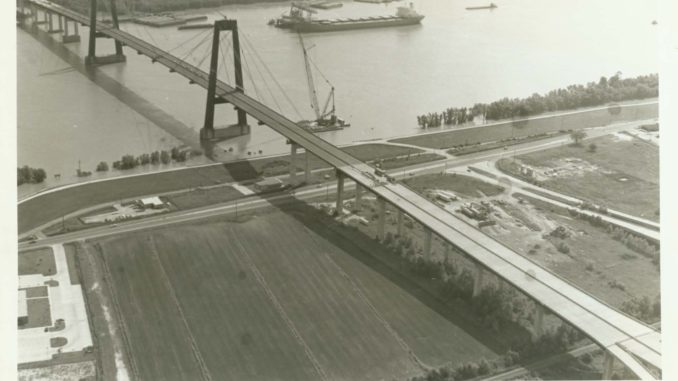
Bridge’s original construction took 9 years, 19,000 tons of steel
It took nine years, 19,000 tons of steel, 72 cables comprised of thousands of wires, 700,000 bolts and 3,000 tons of asphalt to bridge the gap between Luling and Destrehan.
When the Hale Boggs Bridge was completed in 1983, the East and West Banks of St. Charles Parish were finally connected. The bridge is now a landmark in the parish with about 39,000 vehicles crossing it daily.
In the first major work on the bridge since its construction, a $32 million project is underway to replace cables that were showing signs of corrosion.
The project began in 2009 with an estimated end date of this month, February 2011. However, because of delays the project will not be complete until about August 2012 and delays are still in the future for motorists.
Alan Weber, project manager, said that the bridge will be closed for an entire weekend at some point in March. An exact date has not been decided yet. He also said more limited, scheduled closures should be expected in the coming year.
Weber said the setback was caused by engineering issues with the cable system.
“(The contractor) had to make some changes to the bridge before they could put the cables in, which we hadn’t planned on doing,” Weber said.
The contractor was using a replacement cable system that was too large for existing connection points which required costly modifications of the bridge anchors.
Replacement of the cables was called for in 2007 after the Federal Highway Commission rated the bridge a 3 out of a possible 9 due to the effects of weather on the cables.
Each of the 72 cables is being replaced one at a time, Weber said, because the job involves installing a replacement cable next to an existing cable, applying tension and then removing the old cable. The current cables had a lifespan of 25 years, which they lived up to, and the new cables are designed to last 50 years.
The original cost of the bridge was $127 million.
For St. Charles Parish, 1984 was a big year. The Waterford 3 plant was constructed, the World’s Fair came to New Orleans and parish residents were enjoying the perks of finally being able to drive across the Mississippi River on the newly-built Hale Boggs Bridge. It was also announced that year that the bridge would soon connect Highway 90 and Airline Highway.
The idea of bridging the Mississippi between Luling and Destrehan was first suggested in the 1960s when Joel Chaisson Sr. was a candidate for state representative. Once he took office, then-governor John McKeithen formed a Bridge Authority to study the feasibility of the bridge. The authority was made up of Chaisson, Warren Landry, Harold Keller and Lester Millet. After working for three years, the group came up with the idea of a toll bridge that would cost about $42 million to construct at the time. However, McKeithen decided not to move forward with the project.
In 1969, plans for the bridge were dusted off when then-Senator George Oubre and Landry traveled to Washington D.C. to convince Congressman Hale Boggs to include the bridge in his plans to build an interstate loop around New Orleans. Boggs agreed, but nothing was done between 1969 and 1972.
When the bids were finally advertised for the project in 1973, three New Orleans environmental groups immediately filed suit against the state to stop the project.
However, over the next nine years the bridge was indeed constructed and finished in 1983.
The days of ferries in St. Charles Parish were over.
The towers of the bridge rise 400 feet above the water while the bridge itself sits 160 feet above the Mighty Mississippi.
Some information in this story was contributed by a 1984 River Parishes Guide article by Sherry Thompson.



Be the first to comment