
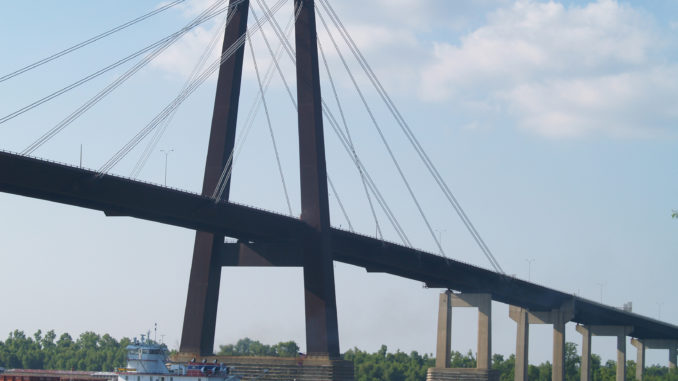
Residents will have to prepare for at least two more full closures of the Hale Boggs Bridge over the next 12 to 14 months of the cable replacement project.
Alan Weber, the project’s manager with the state Department of Transportation and Development, said he is not sure when those closures will take place, but that at least a couple more will happen.
The $32 million project is replacing the 72 cables that support the bridge. The project became a priority after corrosion was found in the cables during inspections. In 2001, the bridge received a 7 out of a possible 9 rating from the Federal Highway Commission, which indicated that it was in good condition. In 2007, that rating had dropped to a 3 due to the effects of weather on the cables.
The job involves installing a replacement cable next to an existing cable, applying tension, then removing the old cable, Weber said. Because of that, each cable is being replaced one at a time.
Before the project began on Sept. 12, Weber said that a full bridge closure was something that the job’s contractor, Kiewit Louisiana, was trying to avoid. However, because replacing the cables occasionally calls for the lifting of heavy pieces of machinery, the company doesn’t want to take the chance of anything falling on motorists.
When the bridge was closed on Oct. 31 and Nov. 1, residents were only warned three days before. However, Weber said that more advanced notice will be given next time the bridge is to close.
“Now, everything is on a schedule, so we should be able to give advanced notice next time we have to close the bridge,” he said.
For a majority of the project, all four lanes have remained open, with two 11-foot lanes on each side allowing traffic to flow. The only thing that has really been affected is the speed limit, which was dropped to 60 miles per hour.
Contractors began replacing cables on the East Bank side of the bridge and work is expected to last for another five to six months. Workers will then move to the West Bank side.
The new cables are made of individually wrapped strands of wire that are more resistant to corrosion than those currently on the bridge. The new cables are designed to last 50 years, while the current cables had a life span of 25 years.



Be the first to comment