
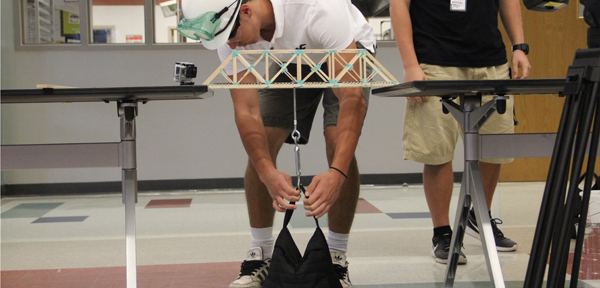
Even after the students had worked their best theory and calculations for the Satellite Center’s engineering design competition, teacher Carlos Mayoral said many of them were still surprised over how well their bridges worked.
“This, of course, is the purpose of the project … to demonstrate that the theory and the math actually work in the real world,” said Mayoral of the Oct. 26 competition. Mayoral is the school’s engineering design and physics facilitator.
In this world, the real-life lesson was a truss bridge, a load-bearing superstructure composed of a truss, with connected elements forming triangular units.
For the five teams that competed in this competition, the suspense was over whose bridge could the handle the most weight or had the most efficient design.
Ashlyn Rieder and Chase Menendez’s design shattered last year’s record of 101 pounds. Weighing less than four-tenths of a pound, the structure held a whopping 108 pounds.“Through completing this project, I learned that it is possible to build a structure out of thin balsa wood and glue that can hold over 100 pounds,” Rieder said. “I also learned critical concepts of physics that can be used in civil engineering.”
Tyler Childress and Chandler Fremen designed the most efficient bridge that weighed less than a quarter of a pound but held 90.5 pounds. Their bridge had the best strength-to-weight ratio, holding 395 pounds its own weight.
“The best part about the project was getting to show the Satellite Center the hard work we put into these bridges, and then we got to break them,” said Childress who hopes this experience in future college classes. “When I take statics in the future, I will have to use the method of joints and the method of sections again. This project allowed me to get a jumpstart on the material I will learn in college while majoring in engineering.”Mayoral said turning the lesson into a competition was aimed at raising student interest and motivation.It worked.
According to Fremen, “What I liked best about participating in this competition was using all my building and thinking skills to put our bridge together. Looking over at the other teams’ progress also motivated me and my partner to make our bridge better than theirs.”
Rieder said her favorite part of the competition was learning how to design a bridge that could hold 300 times its own weight, as well as the critical concepts of physics.Student Ashley Riddick welcomed an experience unique from regular school.“It gave me more insight to the engineering world than I had before,” Riddick said. “I learned the formulas of equilibrium and how forces act upon an object to keep it from moving. Using the formulas, my teammate and I learned how to calculate the forces within the bridge members to see if the bridge itself would fail before the specifications were met.”
Student Hannah Heyl also welcomed real-life learning.
“In school, I never thought I would be able to really apply what I learned to a real life situation, but the satellite center gave me that opportunity,” Heyl said. “I learned to pay attention to details. This is very important when building a bridge and also in everyday life. Finding that one little thing that could possibly cause a catastrophe can save many lives, or many points on your grade.”

Be the first to comment