
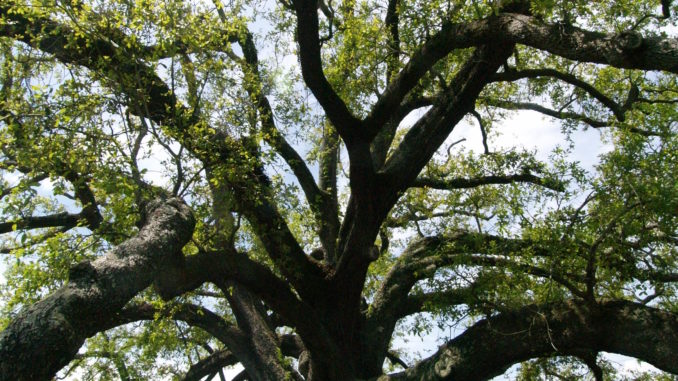
There are over 125 members of the Live Oak Society right in St. Charles Parish, but only one of them is human.
Coleen Perilloux Landry is the only non-tree in the society and has been managing the national registry of Live Oaks since 2001. In that time, Landry has registered 2,435 oaks.
“The job is important because we need to preserve, protect and promote our Live Oak tree – it is a tree not common in the world, though people here think it is,” Landry said. “We’re losing our giant oaks like crazy right now and something’s got to be done about that. They are our legacy – they are one of Louisiana’s great treasures.”
The Live Oak Society was founded by Dr. Edwin Lewis Stephens, the first president of Southwestern Louisiana Institute – now the University of Louisiana in Lafayette.
The society began with 45 members and now boasts 6,195 members in 14 states.
The first “president” of the Live Oak Society when the national organization was formed in 1934 was the Locke Breaux Oak in Taft. The tree was huge, with a girth of 35 feet, and was sponsored by Southern Dairy.
Unfortunately, like other Live Oaks in the country the Locke Breaux Oak was lost to pollution in 1968.
“It was a magnificent oak. When the petro-chemical industry came to St. Charles Parish, air and ground pollution killed it,” Landry said. “People protested so much because people loved that oak…(a chemical plant) thought if they got it out of sight it would be out of mind so they cut it down and they dynamited for two weeks, but they couldn’t get rid of it. They had to go in and dig it up by hand – it was so strong.”
She said that it takes at least 100 years for a Live Oak to mature, so it is naïve to think that planting one tree for every tree cut down is effective.
“You cannot cut one down and plant a small oak and expect to see anything in your lifetime,” she said.
Besides pollution and development, trees are commonly cut down or pruned in Louisiana because of possible storm damage caused by them. However, Landry said this should never be a concern when it comes to Live Oaks.
“Live Oaks are known as hurricane trees…the winds go over the Live Oak and if your house is next to a Live Oak it buffers your house against the wind,” Landry said. “Hardly any Live Oak goes down in a hurricane unless it is waterlogged for weeks. People have climbed in the Live Oaks during hurricanes and have had their lives saved. When in doubt, climb in a Live Oak in a hurricane.”
Landry said that in situations where pruning a Live Oak is necessary, extreme caution should be used.
“Always make a clean cut; it does not need a sealer as it seals itself,” she said. “Do not take off more of a tree than is absolutely necessary.”


Be the first to comment