
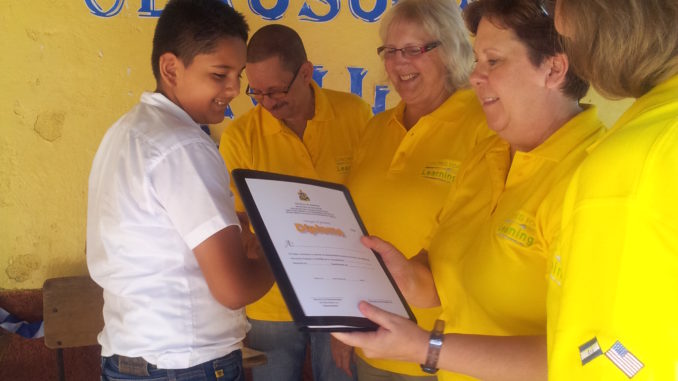
Rotarians travel to Honduras to see firsthand how their efforts change lives
When members of the Rotary Club of St. Charles Parish landed in the Honduran city of Tegucigulpa, they weren’t there to tour Mayan ruins. In fact, their journey took them far from the city lights, up mountain roads and into the small town of Nacaome.
They were there to watch sixth graders graduate.
“It’s hard to convey just how poor these people are,” said Christine Trevett, one of the Rotary Club members who made the journey.
The group was there as part of its charitable efforts through Lunches for Learning. For more than 10 years, the organization has connected donors such as the Rotary Club of St. Charles Parish with schools in a partnership to provide lunches. It costs $150 per student, per school year to provide lunches that the cash-strapped Honduran education system cannot otherwise provide. The modest lunches often include beans, tortillas and rice.
Ron Hicks, founder of Lunches for Learning, said that the Honduran government has a very simple formula for its school system. It knows that a 6-year-old can walk at least two miles. There is no school transportation. The government then builds a school large enough to accommodate all the children in a two mile radius. Then it hires a teacher, or maybe two, if there’s a lot of children in that radius.
Trevett said the schools reminded her of “the stories you hear about way-back-when America”—single-room schoolhouses where one teacher covers multiple subjects across multiple grade levels.
During a visit to Honduras more than a decade ago, Hicks became curious about the number of children who were out begging during the day. After inquiring why the children weren’t in school, he discovered the chilling answer: the children were simply hungry and had to choose between starvation and education.
Hicks, based in Montgomery, Ala., founded Lunches for Learning as a way for groups in the U.S. to help provide the meals needed for school students to get lunch. He said that the dropout rate for Honduran elementary students is as high as thirty percent.
“The dropout rate in the schools that receive lunches? It’s zero,” Hicks said.
The project is particularly poignant for southern Louisiana, as New Orleans plays host to the sixth largest population of Honduran immigrants in the U.S.
The Rotary Club of St. Charles Parish, in conjunction with other efforts, was able to sponsor a school of 62 children that they visited for their graduation in November. The 6th grade graduation in Honduras is significant, as a child that completed that much school is considered literate and can interview for better jobs.
For Trevett and fellow rotarian John Cornwell, this was their first time inside of Honduras.
“I was a little apprehensive, because you hear a lot of stories about the crime,” Trevett said. “But where we were, I felt completely safe.”
Cornwell said that on the way there, you could still see many areas where the children were begging in the streets.“You’re almost embarrassed by what you have here [in the United States],” Cornwell said.
The group from St. Charles Parish was joined by a church group and an individual businessman, who each sponsored their own school. Over two days, the entire group visited graduation ceremonies at all three schools. The Rotary-sponsored school was the largest.“All the children were standing there at the gate, ready to hug you,” laughed Trevett. “Then it was the mothers – then the grandmothers.”
In addition to the meals the children received, the visitors brought a number of other items including books and decorative hair rubber bands for the girls. Trevett said the children were grateful for everything they received.“When we brought the soccer balls out, oh my God, they went crazy,” said Trevett.
Both Trevett and Cornwell are determined to continue the program and to expand its reach. Trevett plans to return to Honduras again next year.
“We are hoping to get more money so that another school can get sponsored because there are plenty of schools that need sponsoring,” she said.
In addition to making the journeys an annual, or even twice-yearly tradition, Cornwell said he plans to advocate for expansion of the Rotary Club’s environment. He will begin a term as the Rotary district governor, and said he hopes to encourage other clubs to contribute.
But both rotarians expressed a profound impact that they had trouble describing to those who have not been there.
“In this country, we have poverty, and we have hunger, but we have a lot of help,” Cornwell said. “But in that country, they have no help, very little help from the government…they are like a forgotten people.”



Be the first to comment