
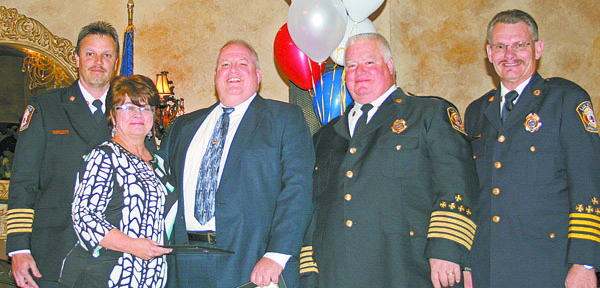
In the many years that Barry Minnich has been with the Luling Volunteer Fire Department, he quickly came to realize his job extended far beyond the fire.
“It really makes you feel good when you can help (people) on a really bad day,” said Minnich, who was recently honored for 40 years of service with the department that included being a firefighter, chief and board president.
“We’ve seen people lose their loved ones and that’s a tough thing to deal with, so if we can make their life a little bit better along the way then it was all worth it.”
Looking back, he recalled the personal sacrifices, too.Of the many fire calls answered, there were also many missed events with his wife and daughters.
He also did shift work at Dow and that further narrowed family time.
“If there is one regret it was how much time I missed with my girls growing up,” said Minnich, whose daughters are in college now. “When it’s gone, it’s gone and I couldn’t get that back with my daughters.”
This was actually the first thing that came to mind when Minnich received the service award.
But he’s making up for lost time with his grandchildren.And Minnich certainly couldn’t forget the camaraderie with fellow firefighters and especially two of his closest friends being among them, although he lost them both to cancer.
He also knows he has 40 fellow firefighters who would help care for his family, and this is connection also keeps him with the department.
In the beginning, he had mixed feelings about the joining the department or at least until a friend pressed him to help because they always needed volunteers.
“I started learning more about how to run a fire engine and fix it,” Minnich said, which was important to do because of the department’s limited budget.
“The interest just grew and here I am today – still in it.”There was an “adrenaline rush” to being in an emergency situation, even though the Luling department is small, and every incident was different.
But, over time, it came to represent an avenue to helping people and expanding his experience in the medical side, which also was important because there weren’t ambulances at the time.
He became an EMT and started an ambulance service with two vehicles and volunteered to run it until the hospital provided a paid service.
Answering emergency calls also introduced him to many people in St. Charles Parish.
“You get to meet all kinds of people – hundreds and hundreds of people – and eventually it seems you know everybody in the parish,” Minnich said.
His affiliation with the department also opened doors in his career.
He worked at Union Carbide (Dow) and then got into emergency response work that directed him in health and safety as a sort of fire chief with the company.Firefighting has changed.
Minnich said finding volunteers remains a constant struggle, many younger people unable to provide the help because of economic pressures that prevent them from having time to help the department.
“When I started, things were not as hectic as it is today,” he said. “You get people who join and they stay a year or two. It’s extremely hard to recruit them, but it’s even harder to retain them.”
There are also more demands, such as training, required to keep a fire insurance rating, which helps to keep homeowner insurance down.
Changes have come in equipment, too.Minnich said everything’s change from protective gear to the fire itself.
“The fire today is a lot more challenging than it was 40 years ago,” he said. “Construction materials have changed.
Everything is not solid wood anymore or tongue and groove where that structure would stand up to just about anything. It could be totally unsafe to enter in 10 minutes.
Because of building construction, everything is glued together and held together by clips instead of a solid roof.”
When heat gets to these clips, they collapse.
Because of these materials, firefighting strategy has had to evolve.
“Residential homes built today are, for the most part, could be considered commercial structures because of the size,” Minnich said.“You take square footage and factor in the time it takes for someone to recognize there’s an emergency – call 911 and dispatch.
The police get there typically first because they’re in their vehicle all the time, the fire department is dispatched and we go to the station and respond.
It may be 15 minutes or more for us to get to the scene, so our challenges are greater in particular with building construction and actually trying to save property and life.
It’s just totally opposite of what it was even 20 years ago. Everything is done quickly and cheaply.”
Minnich said they have to weigh the rick to the benefit on every call.
Firefighting equipment has become much better.
“Back when we started, we were lucky we had personal protection equipment,” he said. “It could be a pair of shorts and a T-shirt, and when we got equipment it was a pair of wader boots and a coat with a plastic helmet – a glorified rain coat with a hat.
Most people didn’t have the breathing air – couldn’t afford it. You just held your breath as long as you could.”
Today’s gear is top of the line, and they ride in an enclosed cab instead of riding on tailboards, Minnich said.By far, his connection to his fellow firefighters has been his strongest hold with the fire department.
“They’re true friendships,” he said. “We’re like any other kind of family. We have our ups and downs, and bicker like a family. There are guys in our department who have been there over 20 years.
We’ve just been together for a long time. It’s kind of neat that way – you’ve always got friends.”
Be the first to comment