
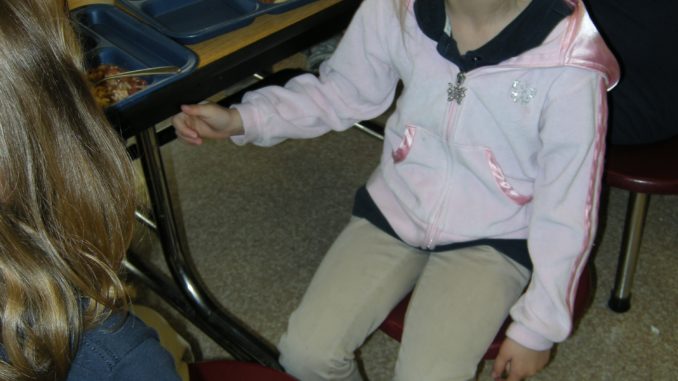
Last year 6-year-old Zoe Aucoin of Des Allemands was diagnosed with epilepsy. Now her family’s determined to spread awareness about this silent illness.
Epilepsy affects over 50 million people worldwide. That’s more than multiple sclerosis, cerebral palsy, muscular dystrophy and Parkinson’s disease combined. And within the last year, epilepsy has claimed another – 6-year-old Zoe Aucoin of Des Allemands.
On Feb. 12, 2008 at 11:45 p.m. Zoe’s mother, Louise, called 911. Her daughter was having a seizure for the first time.
“Our family was stricken with this uncaring illness when our then 5-year-old daughter began to convulse right after falling asleep with my husband and I in bed,” said Louise. “When we first saw her I knew that it was a seizure, but didn’t know what was causing it. It lasted 20 minutes.”
That night Zoe, who is a student at Allemands Elementary in Des Allemands, was rushed to Children’s Hospital in New Orleans where she was submitted to a series of tests.
After two days in the hospital, the results were in. The MRI of Zoe’s brain came back OK, but an electroencephalography (EEG) – a test that can show abnormalities in the brain’s electrical activity – showed epilepsy.
“When we first got the diagnosis at Children’s Hospital we were very upset,” said Louise. “Then I looked at my husband and told him to look around at the other sick kids. We were just grateful that the illness was not caused by a tumor, in a way we felt blessed.”
Zoe’s doctor prescribed her a daily 600-milligram dose of Keppra – an oral medicine used to prevent seizures in epileptic patients.
For 10 months the medicine appeared to be working. But on Dec. 15, 2008, shortly after 11 p.m., Zoe had a break-out seizure – a seizure that occurs while taking anti-seizure medicine.
“It happened shortly after she fell asleep and lasted no longer than 8 minutes,” said Louise. “During the seizure she shook her hands mostly and only drooled a little. She came out of it pretty quickly, but had limited use of the right side of her body and complained of a headache on the left side of her head.”
As a result of the second seizure, Zoe’s doctor increased her daily dose of Keppra to 800 milligrams.
“Unfortunately, the seizures are sometimes hard to control due to the fast growth of the child,” said Louise. “In most cases the medication has to increase to the max-out level according to their weight. Then if the seizures still occur, doctors normally will then switch the child to another medicine.”
Despite Zoe’s new dosage, the seizures continued with her third episode occurring on Dec. 29, 2008 – two weeks after the medicine increase.
“She became very restless and fidgeted around a lot while she was trying to fall asleep,” said Louise. “She complained of not being able to get comfortable and moved around for at least 45 minutes.”
As soon as Zoe did finally get to sleep, the seizure came.
“After she fell asleep it came on and lasted for about 5 minutes,” added Louise. “This time she shook her arms and legs, drooled more, but came out and was more alert than last time.”
Once again Zoe’s medication was increased. This time to 1,200 milligrams a day, but that still wouldn’t prevent another break-out seizure from occurring on Feb. 5.
“Like all the others, the seizure happened right after she fell asleep,” said Louise. “She didn’t drool this time, but was very slow coming out of it. At one point it even seemed like she stopped breathing, her stomach wasn’t moving and her eyes were fixated.”
Zoe’s body didn’t start to move again until 15 seconds after Louise called 911.
“I was in shock and could not shaking,” said Louise. “The paramedics brought her back to Children’s Hospital. She was checked in and discharged that night.”
The next day, Zoe’s doctor added a new medicine to her regimen – 1500 milligrams of Trileptal.
Louise notes that before each seizure Zoe’s energy levels seemed to increase, like a sign that an episode was near.
“Several weeks before her first seizure Zoe showed signs of hyperactivity,” she said. “Her energy level was heightened and I even referred to her as my speedy little robot.”
On March 3 the Aucoins traveled to Baton Rouge for a second opinion.
There they were told that Zoe may have benign rolandic epilepsy – one of the most common epileptic syndromes found it children.
It is called “benign” because it has a good outcome – nearly all children with it will outgrow it during puberty.
Tests to confirm this diagnosis for Zoe are pending.
“Right now we are just more watchful of Zoe’s activities,” said Louise. “She is not allowed to bathe by herself in the bathtub and she can’t go in the pool without someone watching her at all times – even with her safety gear on.”
Louise points out that the family is also cautious of Zoe climbing on anything, monitors her video-game time and caffeine intake, and insures that she eats early just incase a seizure were to occur.
“So far we have been lucky that all the seizures have happened at night,” she said. “But all of Zoe’s teachers are aware of her condition and are on the watchful eye.”
In an effort to increase awareness about epilepsy worldwide, Zoe’s family wants to inform residents about an international grassroots effort that has been developed.
On Thursday, March 26, people from around the globe are asked to wear purple and spread the word about epilepsy. The day has been coined “Purple Day.”
Getting involved locally is easy. Wear purple and encourage others to do the same. Host a “Purple Day” party or fundraising event at your home, business or school. And most importantly, get real facts about epilepsy.
The Louisiana Epilepsy Foundation will also host its 5th annual 5K run/walk in Baton Rouge.
For more information, visit www.seizethedayrace.org and www.purpleday.org.

Be the first to comment