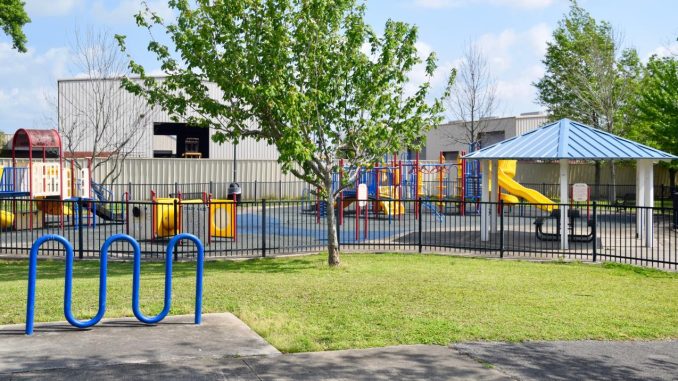
On Monday, the Parish Council unanimously approved the sale of three plots of property that make up Good Hope Park in Norco for a total sale price of $100,000 to Shell Norco.
By Tuesday, the Parks and Recreation Department had announced the permanent closure of the park.
“In the coming weeks, residents can expect to see barricades placed at the park entrance and signage indicating the park’s permanent closure,” the department stated in a press release. “The park will no longer be maintained by the parish, and public access will be restricted. Shell Norco will manage ongoing landscaping needs for the property.”
Good Hope Park, which sits at 500 Goodhope St. within walking distance of several homes, is the second neighborhood park the parish has sold in the last year. The Council approved the auction of the neighborhood park in Fairfield Plantation Oaks subdivision in a 7-2 vote last May, with many residents voicing their disapproval.
Jewell said at the time that parish officials were focusing on park quality over park quantity. A parish rule that requires developers of subdivisions to set aside space for playgrounds or pay a fee to the parish, which has existed since the parish code was adopted, helped expand the parish system to 56 sites, resulting in higher maintenance costs.
“This is within our master plan for recreation, which is investing in our parks that people are utilizing and then divesting in assets that are no longer being used,” Jewell said. “It’s not a fun thing to do. It’s not the first time we’ve done this. It’s not going to be the last one.”
The ordinance approving the sale of Good Hope Park describes the park as underutilized. The Council’s approval of the sale also included a declaration that the property is no longer needed for a public purpose, a legal requirement before the sale could proceed.
But Norco resident Christopher Schaller urged council members to reconsider eliminating the park, arguing that it provides one of the few safe places for neighborhood children to play.
“The area of Good Hope Street between Fifth Street and Third Street is used as a drag strip,” Schaller said. “That is the only place where some of our kids – my ten-year-old daughter and some neighbor kids – go and they play. They ride bikes very close to it.”
Schaller said he was concerned about traffic safety and asked the parish to keep the park if speeding and reckless driving cannot be adequately addressed.
Councilman Bob Fisher responded to Schaller’s concerns about speeding in the area, saying he has worked with the Sheriff’s Office on enforcement efforts and encouraged residents to continue reporting dangerous driving.
Fisher said he supported the sale and noted that the parish has invested heavily in higher-quality recreational facilities throughout the parish.
“One of the things that we promised people when we took office was we were going to improve quality recreation,” he said. “And I think we’d say we’ve done it.”
In recent years, the parish has made investments totaling nearly $1.5 million in facilities such as Bethune Park, Sacred Heart, and the Spillway Park. Funds from the Good Hope purchase will go toward additional improvements at Bethune Park to complement Shell’s $500,000 investment made in 2025.
Jewell also noted that the park was appraised at a total of $55,000, while being sold for a total sale price of $100,000.
The appraisal was affected by restrictions placed on the property when Shell donated the land to the parish in 2006. Those restrictions limit the property’s use to parks and recreation, while multiple pipeline and oil-and-gas servitudes further restrict future development.
Parish Attorney Robert Raymond said Louisiana law requires local governments to advertise a proposed property sale three times within a 15-day period and determine that the property is no longer needed for a public purpose before it can be sold. Because of the restrictions, he said the land has limited value to anyone other than the parish and Shell.
“It can’t ever be used for anything other than a public park or oil and gas conveyances,” Raymond said. “So, it really doesn’t have a whole lot of value to anyone other than to us.”