
Coaches take different strategies to prepare for new surface
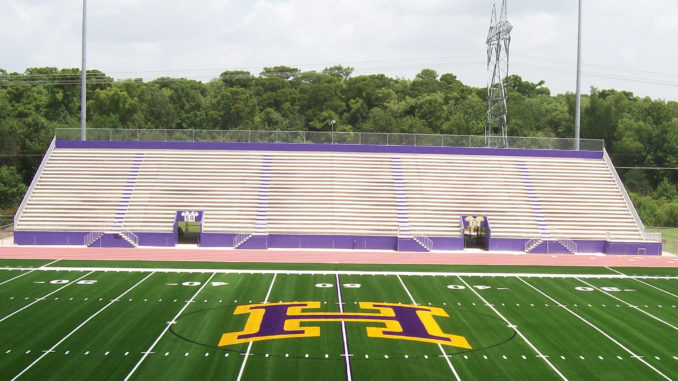
Staring out at the new turf football fields at Destrehan and Hahnville gives one the feeling of looking at a mirage.
Not only are the fields gorgeous, with their bright green coloring highlighted by clearly visible white lettering, but they tend to get hot during the day, which causes heat waves to flutter off of the fields.
Because of the heat factor and the extra padding of the field, Hahnville had to up their conditioning over the summer. Destrehan, meanwhile, did not. In fact, Wildcat head coach Stephen Robicheaux says his team has gone through less conditioning this summer than they normally do.
Neither one believes that the turf will have a negative impact on their team this season.
Once considered a luxury item reserved only for private schools, artificial turf is becoming more and more common on high school fields around the nation. The surface, made with millions of synthetic fibers sewn together with rubber granules, provides more cushion than grass.
That cushion, which has an inch and a half of rubber and sand mixed together, is forgiving on ankles and knees and also reduces helmet-to-surface impact for players. That can drastically lower the number of concussions.
Plus, the new surface negates the impact of rain, allowing different sports to play or practice on one field each school day without losing valuable coaching and learning time.
The turf was installed at both Hahnville and Destrehan over the summer at a total cost of about $2.6 million. Willie Wise, the school district’s athletic director, says that about 70 percent of that cost went into drainage and foundation work. Though the fields were expensive, the drainage system will remain in place when the schools have to re-install the turf, which should be more than 10 to 12 years from now. Wise says that that’s when the schools will begin to see a return on their investment.
Hahnville head coach Lou Valdin, whose team practiced on the turf for the first time on Aug. 12, says the surface has both positives and negatives.
“We don’t like practicing on it because of the heat factor and the strain on the legs, but we like it from a special teams standpoint and from a pass-skeleton standpoint because all of the hash marks are out there,” he said. “So, we’ll do some special teams work and we will bring the quarterbacks out there to work on their passing.”
However, the Tigers did have to go through extra conditioning just to get ready to play on the turf this season.
“Obviously, this year there is a major conditioning concern because we are going to play on turf,” Valdin said. “We have seven games on turf, and we’ve really amped up the conditioning this year knowing that it’s going to be hotter on turf and we have to get acclimated to the heat.
“Traditionally, we don’t run in the mid-afternoon practice at camp, but we did this year. We changed it up to get them used to running in the heat.”
But Valdin doesn’t think that the turf will cause his team any problems.
“I don’t think its going to be a major concern,” he said. “It’s the same type of shoes you wear and we’ve played on it before. In fact, we played on turf all summer at Tulane, so it’s not that big of a deal.”
Destrehan was able to practice on their new field for the first time on Aug. 21.
“We didn’t have to increase our conditioning at all,” Robicheaux said. “In fact, this might be the least amount we’ve gone through.”
Just in case the heat does pose a problem this year, St. Charles Parish Public Schools has purchased two water canons, which cost around $15,000, to be used on the fields if necessary.

Be the first to comment