
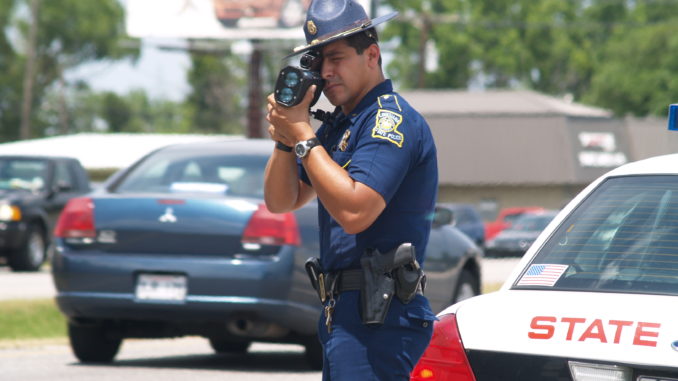
Two Louisiana State Troopers stand in the ready position on Highway 90 in Boutte everyday to catch unsuspecting drivers who might be speeding.
One police officer holds a LIDAR speed detection device and points it at the front of a car’s bumper, while the other uniformed officer helps to nab those drivers that break the speed limit by standing in the middle of the road and signaling them to pull over.
“The troopers are able to wave down and ticket several drivers in a row for speeding because their detection device is just that good,” Joseph Piglia, public information officer for the LST, said. “The LIDAR detection method isn’t something new that we’re using to catch driver’s speeding in their vehicles. It’s been around since the early 90’s.”
Piglia says that Highway 90 is often an area where people disregard the speed limits, so the troopers have taken the appropriate action to lower those speeds.
“In Paradis, right near the school, people have a tendency to disregard the 35 to 45 mile per hour speed limits,” Piglia said. “We prefer the LIDAR detection method to radar because the LIDAR shows an exact rate of speed for that vehicle.”
Troopers point the device at the bumper of a car, which sends out an infrared dot and then generates an exact computer generated number that tells what speed the vehicle is traveling.
“All of our troopers are trained to use the device and receive a certification at the end of the training,” Piglia said. “They are also instructed on being able to detect the rate of speed from observation.”
Piglia says the two troopers working together have to rely on both skills when it comes to catching vehicles speeding.
“It’s not an easy job and there are some safety concerns,” he said. “That’s why the officers usually work in pairs.”
Piglia says some drivers ignore the troopers, even when told to stop and pull over on the side of the road.
“They keep driving sometimes,” he said. “That’s when our guys get in their vehicles and have to track them down.”
LIDAR is better suited than radar because it makes it easier for the troopers to determine how fast each individual vehicle is traveling.
“For example, if an 18-wheeler is driving next to a regular vehicle, and both are speeding, the radar will pick up the speed of the 18-wheeler before it will detect the speed of the smaller vehicle,” he said.
And Piglia hopes LIDAR will help keep parish residents safe.
“Drivers do a lot of multi-tasking behind the wheel these days and so they’re not paying attention,” Piglia said. “So, making sure they’re driving safely is important.”
Be the first to comment