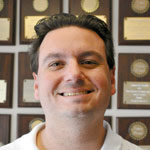

Kevin Friloux looks back more than 40 years ago and recalls having some unique ambitions for his age.
“I was kind of an unusual young person,” said Friloux, now 75. “When I went off to college and my objective was to come back and work in parish government in some capacity.”
Those unique ambitions led him down the road less traveled – and in fact, a road never traveled before in St. Charles Parish.
Friloux holds the distinction of being St. Charles Parish’s very first parish president, officially taking that office in 1980. The position of parish president was among the changes swept in following the ratification of the Louisiana Constitution of 1974, which provided the people of a parish the option to adopt its own laws – this form of government was called home rule.
Voters made clear that home rule was the path they desired, and in 1980 St. Charles Parish officially shifted from a police jury system to home rule. St. Charles Parish was among the very first parishes to adopt this kind of government structure.
After earning his degree, Friloux’s first job came with the St. Charles Parish police jury in 1976 as an assistant to the parish administrator.
The 1970s were a time of political upheaval locally. In December of 1976, four members of the parish’s police jury pleaded guilty to charges connected to their roles in a financial kickback scandal and went on to serve time in prison.
“It was a huge uproar in the parish,” Friloux said. “And so four months after I was hired on as an assistant to the administrator, they appointed me the parish administrator.”
That was an entirely new world of responsibility thrust upon Friloux, who was just 26 years old at the time, the youngest person in the country to hold that position.
On the other hand, Friloux long envisioned working in parish government. Now, he was in the middle of everything.
He admits he had a lot to learn.
“It was kind of the old, proverbial dog chasing a car. What do you do when you catch the car?” Friloux said. “But I worked with some very good people who helped me out.”
The scandal created fertile ground for change. Home rule government passed overwhelmingly when it was on the ballot, and Friloux decided he would run for the new office.
 “I never considered myself to be a great politician,” said Friloux. “But I went to every subdivision, every community in the parish that year and went door to door. And I think when people saw me in the community and saw people working with me, they felt comfortable with voting for me, even though I was so young at the time. I think they saw some things I did early on as administrator that showed I could do the job honestly.”
The election went to a runoff, where Friloux was the victor – now making him the youngest chief executive officer of any parish in the country.
This meant his administration and the parish council would be tasked with establishing an entirely new form of government locally.
“Those next four years, it was a lot of turmoil because changing from the police jury to the president-council system was a completely different animal,” Friloux said.
He credited Joan Becnel, the parish council secretary, Roland Becnel, the parish’s treasurer, and Tim Vial, the parish’s chief administrative officer, among those who were invaluable toward working through it.
Friloux was re-elected in 1983 and he led the parish for another four years. His bid for a third term was unsuccessful, bringing his time in the role to an end.
“It was challenging, but I liked the challenge,” said Friloux. “It was kind of remarkable that I was elected the second time because a lot of places that went through that transition (from police jury to a president-council system), re-election didn’t happen. It didn’t happen in Lafourche and it didn’t happen in St. Tammany. But I was fortunate I had some really good council members who took a very active role in day-to-day affairs, and I had good relationships with virtually all of them. That was a big help.”
Though it wasn’t easy, Friloux loved the job.
“It’s probably the only job where I truly went to work and didn’t consider it to be work,” said Friloux.
The foundation of St. Charles Parish’s government structure was set in those days, and that structure has stood the test of time since.
“We were able to make the transition and set up the entire government system that continues to operate in that same way today. There have been some changes here and there, but for the most part, the structure has been virtually unchanged,” Friloux said.
Another highlight he counts among favorites is receiving the Monte M. Lemann Award from the Louisiana Civil Service League.
While he was in office, the parish made a deal with New Orleans and Kenner leadership that St. Charles Parish would receive revenue from the New Orleans International Airport in exchange for allowing it to extend its runway into St. Charles Parish – 15.5 percent of sales tax revenue from the airport goes to St. Charles, an agreement still in place today.
Under his watch the parish also instituted a new road maintenance system that placed all roads into an 8-year cycle to receive attention and repair.
“It took some of the politics out of it so that somebody can’t go in and say, ‘I want to blacktop this road strictly because it’s in an area that will net me a lot of votes,’” Friloux said.
The parish also instituted parish-wide garbage and sewer systems during his tenure.
After his time in office came to an end, Friloux went on to work with the parish’s school board, then later went into real estate.
He and his wife retired eight years ago and are now enjoying life in Vidalia.
“God’s been good to me. My kids are doing fine,” Friloux said. “We’ve got nine grandkids, two great-grandkids and we’ve got a great-great grandkid on the way. We’ve been blessed.”