
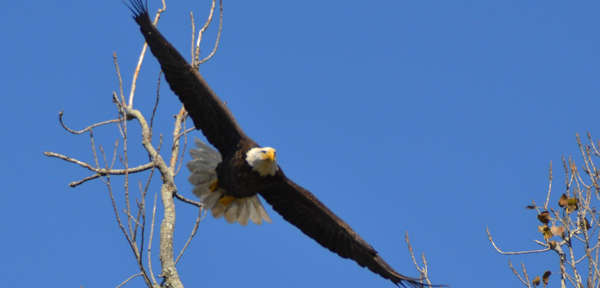
The sight of bald eagles in St. Charles Parish has become increasingly common in recent years, and it’s a trend that seems likely to continue, according to Michael Seymour of the Louisiana Department of Wildlife and Fisheries.
Seymour, the department’s ornithologist, said a recent aerial survey revealed 647 bald eagle nests, 353 of those considered to be “active” nests. The survey originally was aimed at finding the 520 nests the department knew about, meaning the numbers came back stronger than expected. The survey took place over 2014 and 2015.
“Their numbers are definitely increasing, especially at this point,” Seymour said. “There’s certainly no reason for concern.”
Seymour said once baby eagles hatch from a nest and reach eight to 10 weeks old, that nest is considered a successful one. 76 percent of the nests surveyed met that threshold, each producing an average of 1.5 chicks.
The nests to survey were selected from data garnered dating back to the 1970s, each pre-selected nest one known to be active at least once in the past decade.
Laws have improved their prospects significantly, Seymour said. Three of them in particular have made their lives a bit easier: the Migratory Bird Treaty Act of 1918, which protects building and active nests; the Bald and Golden Eagle Protection Act of 1962, which protects nests even if they’re not active; and the Endangered Species Act of 1973, which governs the conservation of those species and the ecosystems on which they depend.
Another assist to the cause is the banning of the pesticide DDT in 1972, said Seymour, as eagles became poisoned by eating fish contaminated with it. A similar aid, he said, is the banning of lead shot use for water fowl hunting, as eagles suffered lead poisoning by eating animals that consumed lead.
The one instance Seymour could report a decline was in the number of active nests, to 353 from a mark of 380 found in 2008, when the survey had last been done. He didn’t believe that drop off was a significant sign of any kind of trouble.
“It’s not a significant decrease, to me,” Seymour said. “With a number as small, you could be dealing with an anomaly, bad weather, anything. From what we’re seeing, their population is increasing, or at the very least, stable.”




Be the first to comment