
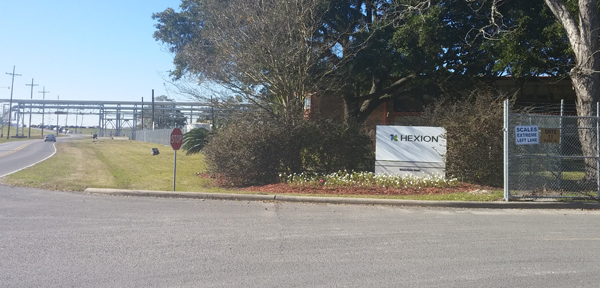
Company expanding business in Asia, workers given option to transfer to other sites
Hexion Inc. announced it would likely close its Norco operation by June, a move that could affect an estimated 100 employees.
Company spokesman John Kompa said Hexion announced “a potential strategic change within its epoxy manufacturing grid to restructure operations at its Norco, Louisiana, site.” The changes are “in response to large capacity additions in Asia combined with softening global demand for epichlorohydrin (ECH).”
Hexion intends to purchase less costing ECH from Asia, which has an over capacity of the resin, and the move its resins product line to other Hexion facilities in the U.S. and Europe. If the plant closure occurs, it would end ECH and specialty epoxy products manufacturing at the company’s Momentive Specialty Chemicals site by late June.
“Under this proposal, the company intends to continue producing specialty epoxy products at other existing Hexion manufacturing sites,” according to Kompa. “The company’s internal requirements for ECH would be met by long-term strategic purchasing arrangements. The company is evaluating the contemplated changes with several constituents, including the union represents associates at the Norco site.”
Hexion workers are with local United Steelworkers (USW) union 750.
Brent Petit, USW staff representative of 18 area union groups, said they had an initial “effects bargaining” meeting with company executives after they notified the union of the possible closure. Petit said more than 60 union workers will be affected by the change if implemented.
“We’ll have employees that will be affected and we need to sit down and discuss how it will affect them,” Petit said. “There are a whole lot of issues that could be impacted. They’re putting a plan together.”
Petit said they were told “the market and competitive landscape has structurally changed.” In 2012, a free trade agreement with South Korea resulted in a 5 percent reduction in import duty on both ECH and LER (liquid epoxy resin) that hurt profit margins. He said Hexion stated “the global BERI cycles will have lower peak profitability and longer troughs than historical trends.”
Petit also said the union met with Congressman Cedric Richmond’s staffer James Berhnard Tuesday in New Orleans and delivered the union’s letter opposing the Trans-Pacific Partnership, also known as TPP, a trade agreement among the Pacific Rim countries outlining global trade.
At Hexion’s Norco site, Paul Barletta, vice president of global epoxy manufacturing, said the plan is to close the site with a gradual closing to be completed by late June.
The move will affect an estimated 100 employees, although some will have the option to transfer to other company operations.
Barletta, who has been with Hexion 16 years in Norco, will remain with the company because of his global responsibilities, but fellow employees could have the option of transferring to other company operations or get new jobs with St. Charles Parish’s substantial chemical industry.
June is the targeted closure time, but Barletta said a definitive close date is pending numerous “different agreements between the site and companies in Norco.” The company initiated the closure by meeting with the union.Kompa added, “We certainly regret the uncertainty created by the announcement of these proposed actions for our associates, the proposed changes would help with the continued growth and health of the business.”
Dan Borne’, president of the Louisiana Chemical Association, said he doesn’t see these changes as a trend.
“Companies have very different supply chains and most have alternate means of sourcing materials,” Borne’ said. “A more noticeable trend is that over half of the new capital investment announced in U.S. chemical manufacturing is coming from overseas, meaning that companies headquartered in other parts of the world recognize America and the Gulf Coast as outstanding areas to locate plants.”
Louisiana chemical manufacturing is growing, he said.Baton Rouge economist Loren Scott estimates some $20 billion is being invested in the state in new or modernized plants.
“That is great news for the Louisiana economy, for job growth and for all the companies that supply the plants,” Borne’ said. “Dr. Scott also estimates another $20 billion is ‘in the cue’ and could materialize down the road.”Borne’ said chemical and petrochemical jobs are growing.
“Over the last three or four years, we’ve averaged nearly 1,000 additional jobs at our plants,” he said. “That’s because natural gas, which we use like a bakery shop uses flour, is plentiful and competitively priced. From 1999 to 2009, we lost an average of 1,000 jobs a year at our plants, much because of high natural gas prices. The shale boom has reversed this trend and that’s good news for Louisiana.”
According to Hexion’s third-quarter earnings statement, the company reported a 21 percent decrease in 2015 revenue, falling to $1.1 billion, because of a stronger U.S. dollar, softening volume demand and declining oil prices driving down selling prices. It also reported a 12 percent decline in quarterly net sales. The report also states Hexion completed acquiring a joint venture partner state in a phenolic specialty resins manufacturing facility in China.Hexion President Craig Morrison said in the statement that the Asian market is largely driven by China, although that market has been slowing down.
The quarterly statement also shows the company will “continue to execute on our latest cost savings program and have achieved $16 million in savings in the first five months of 2015. We expect to realize additional $14 million in savings over the next nine months.”
Hexion also states in the quarterly report that its projecting growth in its Latin American formaldehyde and forest products resins business, driven by furniture, construction, industrial and export markets.
Senior Vice President George Knight also reported the company’s epoxy, phenolic and coating resin segment reached $669 million in revenue, reflecting a 24 percent decrease from the prior year due to an 11 percent drop in demand.



Be the first to comment