
Capture of antimatter hailed as one
A physics professor, who grew up in Destrehan, was part of a group of scientists that made a huge breakthrough that could eventually unlock some of the universe’s best-kept secrets.
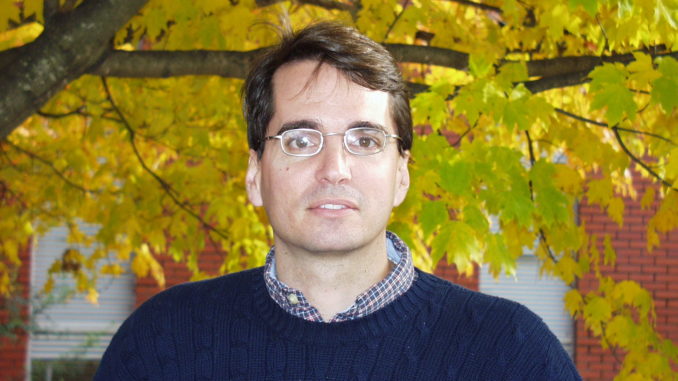
Auburn University physics professor Francis Robicheaux, 46, and 16 other researchers at CERN, a Geneva-based particle physics laboratory, have captured antimatter atoms for the first time. The announcement, which was covered by major news outlets across the world, has generated a lot of buzz in the scientific community. Most scientists believe that when the universe was created, matter and antimatter were produced in equal amounts. But because our world is made up of matter, antimatter seems to have disappeared.
According to Space.com, antimatter has tremendous energy potential if it could ever be harnessed. A solar flare in July 2002 created about a pound of antimatter, according to new NASA-led research. That’s enough to power the United States for two days.
“It is a strange aspect of our universe that it is made up almost exclusively of matter. This is a huge mystery,” Robicheaux said. “Every time we convert energy into matter, the antimatter particle is always made as well. We don’t know of a process that breaks this symmetry sufficiently to explain the imbalance between matter and antimatter in the universe.”
Robicheaux’s love of physics first took root in Destrehan. He spent most of his early years in the area and attended St. Charles Borromeo in Destrehan before heading to St. Charles Catholic.
“St. Charles High School moved from Destrehan to LaPlace when I was a freshman, so we were the first class to go all four years in LaPlace,” Robicheaux said. “Destrehan was a lot less populated then. I remember hunting in spots that now have houses.”
Robicheaux said he drifted into physics because both of his parents were math teachers. His father, Frank, taught at Destrehan High School, while his mother, Laura, taught at the junior high.
“I sort of had a knack for math and when I got to high school one of the more interesting classes was physics,” Robicheaux said. “Physics is about how the universe works and I thought it was cool that you could understand a lot of the details.
“It was even more interesting that not everything was known. Almost all of the fun as a professional physicist is in understanding something that no one thought of before.”
Ten years ago, Robicheaux got involved with something that would change his life. He was on sabbatical in Amsterdam when he began performing calculations on antimatter. Because of Robicheaux’s experience in simulating how the antihydrogen atom (antimatter) formed, he was asked to join the ALPHA collaboration, and the group has spent the last five years trying to capture antimatter.
“The reason we study the antimatter version of the hydrogen atom is that we are trying to understand a basic property of the universe,” Robicheaux said. “There is a prediction that matter and antimatter hydrogen should behave exactly the same. If we find any kind of difference, even a difference as small as one part in a million-billion, this would overturn one of the most fundamental principles in physics.”
Before the ALPHA group’s breakthrough, antimatter had only existed on paper, though it has made several appearances in science fiction. In “Star Trek,” the energy generated when matter and antimatter collided sent the Starship Enterprise into time-warping speeds. In “Angels and Demons,” a movie starring Tom Hanks, a secret society is bent on destroying Vatican City by using an antimatter bomb.
Antimatter was actually first predicted in 1931 by Paul Dirac, who theorized that antimatter is ordinary matter in reverse. But antimatter has been difficult to capture because matter destroys it on contact.
“So you have to capture the antihydrogen without letting anything touch it,” Robicheaux said. “We can capture them using electric and magnetic forces.”
But it’s not as easy as it sounds.
To capture the antimatter, the group used a hollow tube that is about two inches wide and four feet long, which also happens to be an extremely high vacuum. The cylinder is cooled to about -449 degrees Fahrenheit and is surrounded with superconducting wires that make extremely large magnetic fields with a current that runs through them.
“It is the magnetic field which directs the motion of the antihydrogen and prevents it from hitting the wall,” Robicheaux said. “The difficulty is that we are holding the antihydrogen atom using magnetic forces and these forces are incredibly weak.”
The researchers were still able to create 38 antihydrogen atoms, which were held for about a tenth of a second. That was long enough to do the first studies of the atom’s properties, Robicheaux said.
“Since then, we’ve actually studied how long the antihydrogen could be held,” he added. “Because the results have not been cleared yet, all I can say is that the time we have demonstrated we could hold them is much, much longer.”
In fact, Robicheaux said that researchers can now hold the antihydrogen for so long that you would get bored waiting for the experiment to complete. But now that the initial breakthrough has been made, Robicheaux said it is “back to the salt mines.”
“If the experiments show a clear departure from what is measured for hydrogen, then it will certainly be the biggest physics result this decade,” he said.


Be the first to comment